You're working harder than ever and the needle won't move. That's not laziness, and it's not lost motivation — it's a capacity ceiling. Here's how to spot it, and the one shift that raises it.
By Freddie Scott II
Founder, Unlock The Champion · Penn State · 4 NFL Seasons
You're not out of effort. You're out of ceiling.
For years, my answer to everything was more. More reps. More hours. More grind. It had always worked — until I hit a wall that no amount of effort could push through, and I couldn't figure out why.
I wasn't lazy. I wasn't unmotivated. If anything I was trying harder than I ever had. And the harder I pushed, the more stuck I felt. If you're reading this, you probably know the feeling: you're doing everything right, on paper, and something still isn't moving.
Here's what took me too long to learn. That wall has a name, and it isn't burnout the way people usually mean it — collapsed on the couch, can't get up. This is the high-functioning version: you're still performing, still showing up, still delivering. You've just quietly stopped rising. And more effort against that wall only gets you more tired at the same height.
It's not a motivation problem. It's a capacity ceiling.
Most advice aimed at people who feel stuck assumes the problem is drive. Get up earlier. Want it more. Hustle harder. But you don't have a drive problem — if you did, you wouldn't be exhausted from how hard you're already going.
What you have is a capacity ceiling: you've maxed out how much you can currently carry, and the answer isn't to carry it harder. It's to build the capacity to carry more. Motivation gets you to the ceiling. Only capacity raises it.
“
You don't have a motivation problem. You have a capacity ceiling.
The Founder's Desk · Freddie Scott II
7 signs you've plateaued (not quit)
High-functioning burnout hides because it looks like effort. Here's how to tell the difference — if three or more of these are true, you're not slipping, you're capped.
1. Your effort is up but the needle is flat. You're putting in more than ever and the results have gone sideways. That gap between input and output is the clearest signal you're pushing against a ceiling, not a finish line.
2. Rest doesn't refill you anymore. You took the weekend, the vacation, the long break — and came back just as drained. When rest stops restoring you, the problem isn't sleep. It's capacity.
3. The wins feel hollow. You hit the goal you chased for a year and felt… nothing. Just a quiet “okay, what's next.” When achievement stops landing, you've outgrown the game you're still playing.
4. You're winning in one area and quietly losing in others. Work is climbing — but your health, your marriage, or your peace is paying for it. High performers rarely fall apart everywhere at once. They over-fund one arena and let the others erode.
5. Everything runs through you. You can't step back without it wobbling, so you never step back. That's not indispensability — it's a ceiling with your name on it.
6. You're running on willpower. Things that used to be automatic now take a gritted-teeth act of will. When you're white-knuckling your own routines, the tank is closer to empty than the calendar admits.
7. You haven't actually grown in a while. Same level, same problems, more input — for a year or more. You're busy, but you're not building. That's the plateau in its purest form.
Why more effort makes it worse
Here's the trap. Every one of those signs looks like it should be solved by trying harder — so that's what capable people do. They add. More hours, more discipline, more systems, more pressure on themselves.
But you can't out-effort a ceiling. Adding load to a system that's already maxed doesn't raise the roof — it just cracks the walls. That's exactly the moment the strong ones start losing the areas that matter most, because the only place left to pull from is their health, their relationships, and their peace.
The way through isn't more effort. It's more capacity.
“
You can't out-effort a ceiling. Adding load just cracks the walls.
The Founder's Desk · Freddie Scott II
How to raise the ceiling (a practical start)
I spent 12 years building the capacity framework I now use with NFL teams, the NFLPA, Penn State Athletics, and Power-5 programs — but you don't need any of that to start this week. You need three moves.
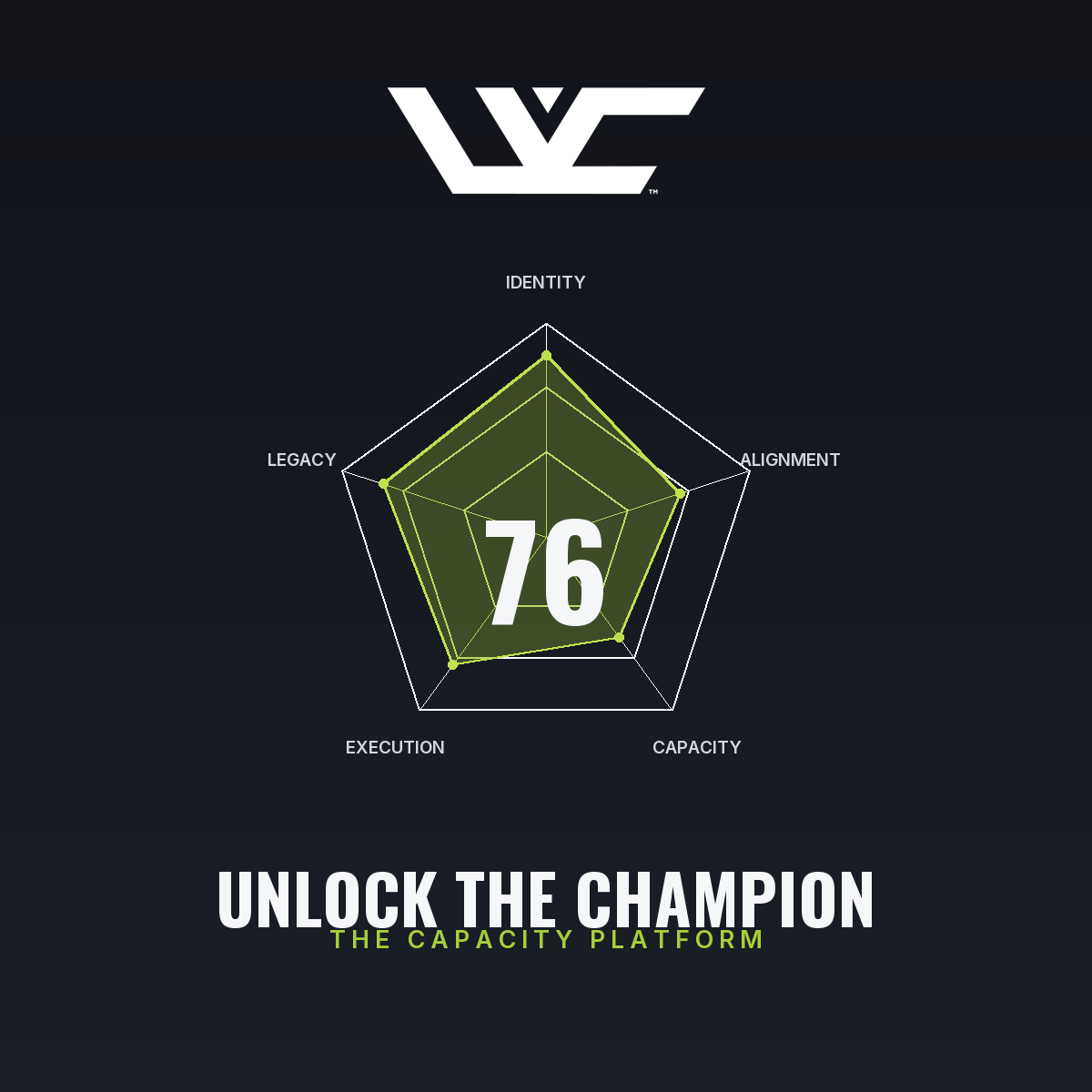
1. Name the ceiling. Capacity lives in five areas — Identity, Alignment, Capacity, Execution, and Legacy. Plateaus almost always trace to one that's quietly maxed. You can't fix a ceiling you can't see, so the first move is to find which one is capping you. Guessing keeps you stuck.
2. Stop adding. Start building. For one week, add nothing new. Instead, pick the one area you named and give it a single 10-minute rep a day. Capacity isn't built by heroic overhauls — it's built by small, repeatable reps on the thing that's actually the constraint.
3. Rebalance the arenas. Look at your three arenas — personal, relational, organizational. The one you've been starving is usually where the next level is hiding. A win at work you can't enjoy at home isn't a win. It's a trade you didn't agree to.
What changes when you stop grinding and start building
This is the part nobody promises you, because it doesn't sound like hustle: the goal isn't to do more. It's to have more of you to give what you're already doing.
Same calendar. More presence at home. Sharper at work. Steadier in yourself. Not because you added another system — because you raised the ceiling underneath everything. That's what capacity buys you, and it's available to you at a level you haven't touched yet.
You were made for more. But more was never going to come from more effort. It comes from more capacity — and the first step is seeing the ceiling you've been pushing against.
Free Guide
See the ceiling you can't see — then break it.
There's More In You is a free guide that names the invisible ceiling quietly capping you — and the one move that raises it. No cost. Read it in one sitting.
The free Capacity Read shows you which of the five areas is capping you right now — in about five minutes. Or build the daily reps that raise the ceiling inside The Pride.