You've felt it: the season turns, the pressure climbs, and instead of getting stronger your team gets smaller. People go quiet. Your best ones start carrying too much. What you actually want is the opposite — a team that takes a hit and still holds its standard on Monday, people who get sturdier under load instead of cracking under it. That's not wishful thinking. It's buildable.
Here's what changes when you get it right: you stop guessing about your people. You can see the strain before it becomes a resignation, and you pour your effort into what's actually weak instead of what merely looks weak. The same energy you're already spending finally lands — because you aimed it before the load arrived, not after.
And the order matters. You don't program a strength plan before you know the numbers. You don't call a play before you read the field. So before you spend a dollar developing your team, you get one clear picture of where they truly stand.
First, see where they stand
You can't develop what you can't see. Most teams are strong on the things that are easy to measure — skill, effort, output — and blind to the thing that actually predicts whether people hold up: their ability to carry the weight of the role without cracking. That's the part that moves first, and it's the part nobody's watching.
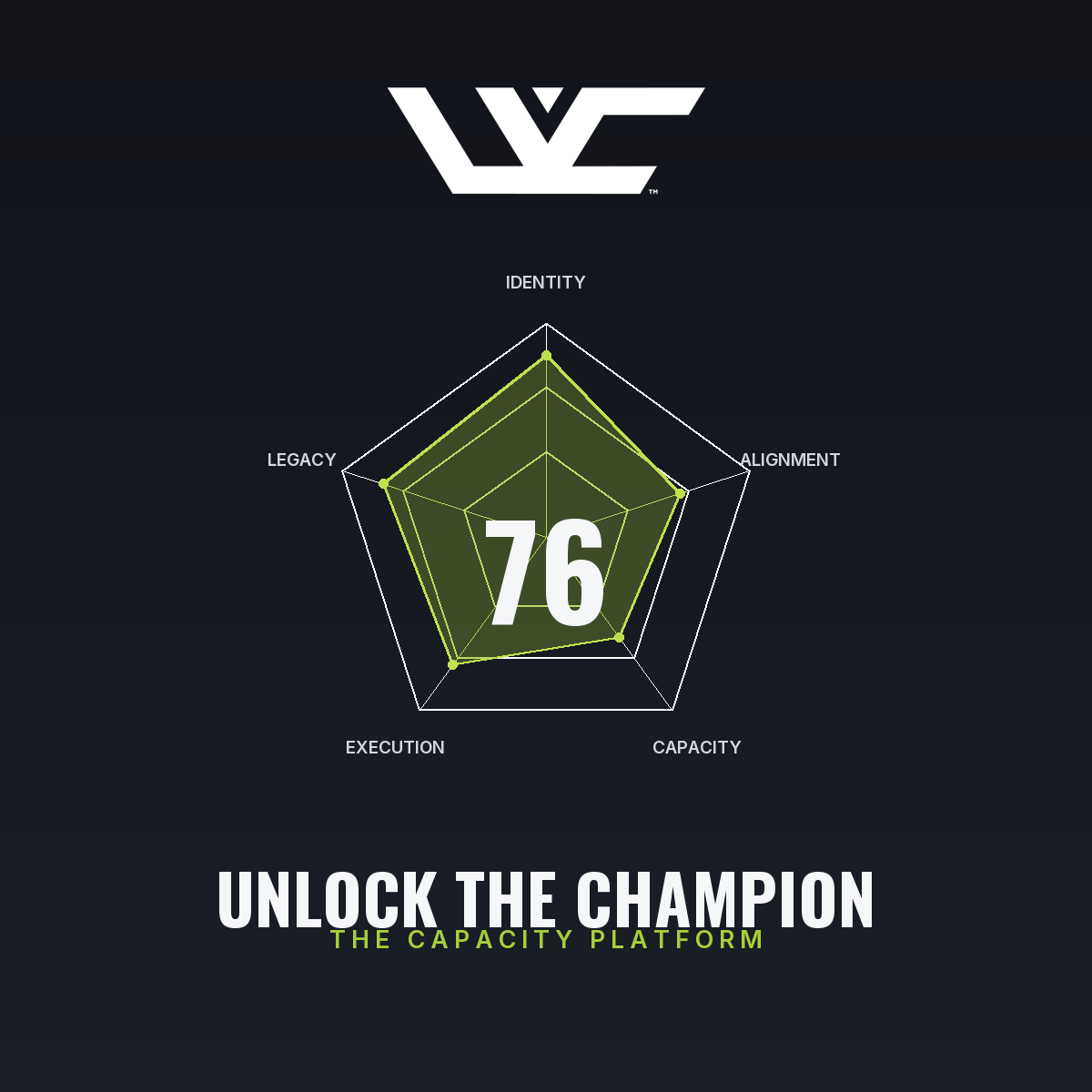
The free Capacity Read gives you that picture in about ten minutes. No facilitator. No calendar invite. You get an honest read on where your people stand across five plain areas — Identity, Alignment, Capacity, Execution, and Legacy — and the one move that grows the weakest one first.
Think of it as the read before the resignation. It shows up before your retention numbers move, before engagement dips, before the quiet checkout surfaces in a one-on-one. You get a baseline — a clear, scannable picture of where your people actually are today — so you can act while you still have room to.
That's the read. And a read, by itself, doesn't build the team. What you do next does.
Then build where it's weak
Once you can see it, the work gets simple to aim. You stop spreading development evenly across everyone and start pouring it exactly where the strain is.
A great strength coach doesn't hand you a number and walk away. They build a program around your gaps, put you under real load, and stay in the room while you grow. Building a team works the same way — human, high-touch work that sticks because real people stay accountable to each other, aimed at the weak areas and pressure points the read surfaced instead of scattered across the whole roster.
Say the read shows alignment is fracturing under change. Now you know where to spend the meetings, the coaching, the cohorts — on the actual crack, not on a guess. (The deeper, people-led side of this work — the Made for More framework and The Pride, our ongoing community and coaching — is the step you take later, only when you're ready.)
Seeing it points at the problem. Building it solves it. Get the order right — see it first, then build — and every hour you spend on your people compounds instead of scattering.
What you get from getting the order right
Here's the part that changes how it feels to lead under pressure: you stop flying blind.
See it first. Build it second. That's the entire discipline — and it's what turns effort into a team that holds. The seeing keeps the building honest. The building gives the seeing somewhere to go.
And you, the leader, get the thing most never get: proof of where your people actually stand, and a clear next move instead of a hunch. You don't have to choose blindly or invest in the dark. You start where the friction is lowest, and go deeper when you're ready.
The pressure isn't going to pause so your people can catch their breath. But a team that's been seen clearly and built on purpose meets it standing.
Where to start
Start with the free Capacity Read at unlockthechampion.com/app/audit. In about ten minutes you'll see where your people stand across the five areas — no cost, no calendar, no commitment — and the one move that grows the weakest area first.
You'll walk away knowing exactly what to build before you spend a dollar developing it. That's the whole point — aim first, then invest.
See it first. Then build it. It starts with one honest look at where your people stand today.