What the NFL Taught MeAbout Why TalentedOrganizations Stall
The most talented team on paper doesn’t always win. The gap between the roster that pulls away and the one that stalls is almost never a talent gap — it’s a capacity gap.
By Freddie Scott II
Founder, Unlock The Champion
The locker room taught me the word before I had it: capacity
The most talented team doesn’t always win
I came into the NFL undrafted. No draft-day phone call, no guaranteed roster spot, no signing bonus doing the talking for me. Four seasons later, I’d seen enough locker rooms to learn something that has shaped every conversation I’ve had with leaders since.
The most talented team on paper doesn’t always win. Not in football. Not in business.
If talent were the whole story, you could rank every roster by the scouting reports and call the season. But anyone who has spent time inside a high-performing organization knows it doesn’t work that way. There are loaded teams that underperform and overlooked teams that go further than anyone expected. The gap between those two outcomes is almost never a talent gap.
It’s a capacity gap.
The word the locker room taught me
In the locker room, you can feel capacity before you can measure it. Two players with the same physical gifts, the same playbook, the same reps — and one of them keeps climbing while the other plateaus or comes apart. The difference shows up under pressure, in the fourth quarter, in the moment after a mistake, in how a guy carries himself when the season gets long.
What I was watching, though I didn’t have the language for it yet, was capacity. The ability to hold weight — pressure, responsibility, adversity, expectation — and keep performing, keep leading, keep showing up as yourself.
Talent gets you drafted. Capacity is what lets you last.
Years later, working inside high-performing organizations, I kept seeing the same pattern off the field that I’d felt on it. The team had the people. The people had the skill. And still, something stalled. Not because anyone lacked ability, but because the organization’s capacity to carry what it was being asked to carry hadn’t caught up to its ambition.
“
Talent gets you drafted. Capacity is what lets you last.
The Founder's Desk · Freddie Scott II
You feel it before you can prove it
Long before any of it reaches a spreadsheet, you can feel it in the building. Friction where there used to be flow. A great decision that takes twice as long as it should. Your best people quietly checking out — still showing up, still competent, but no longer leaning in. That’s the real story, and it’s already happening now, weeks or months before the numbers admit it.
Revenue, turnover, a culture problem that finally boils over into a resignation or a missed number — that’s the box score. It only tells you what already happened. The thing underneath it — whether your people still have the room to carry what you’re asking them to carry — is what actually moves first.
Performance, conduct, and retention all trace back to the same root. When people have the capacity to carry their role, they perform, they make good decisions under pressure, and they stay. When it runs short, you see the small things first — and if you know to look, you can act while there’s still time.
The leaders who win the long game learn to read that the way a great coach reads a locker room — not by waiting for the scoreboard, but by paying attention to the people while there’s still time to do something about it.
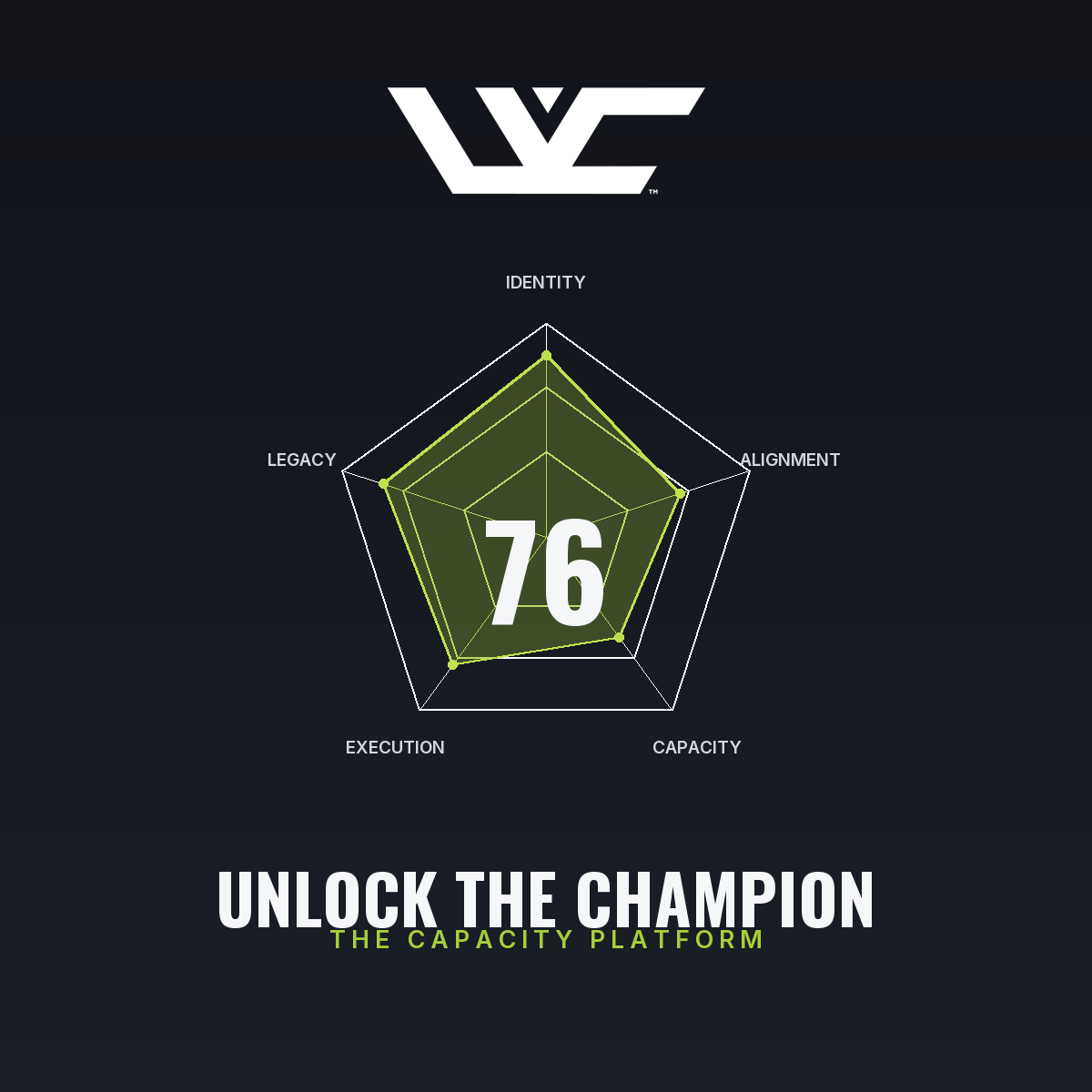
IdentityAlignmentCapacityExecutionLegacy
Two halves of the same work
This matters to me because I’ve spent the last several years building around exactly this idea, and it splits cleanly into two halves.
The first half is measuring capacity — making something you used to only feel in a locker room visible, specific, and trackable. That’s the work of Unlock The Champion: a free Capacity Read built on five areas — Identity, Alignment, Capacity, Execution, and Legacy. It gives a person or a team an honest baseline. (Penn State’s own Dr. Omar X. Easy, Assistant Athletics Director, has endorsed this capacity work — which means a lot coming from inside Happy Valley.)
The second half is building capacity once you can see it — the deeper, human, in-the-room work of strengthening an organization so it can carry more. That’s the Made for More framework, and The Pride, our ongoing community and coaching that keeps people growing long after the read. I’ll go deep on that side in the pieces ahead.
For today, I only want you to sit with the measuring half. You can’t build on a baseline you’ve never taken.
Measure it first
The thing you used to only feel in a locker room — now visible across five areas.
Start where every champion starts — honestly
Every athlete I respected had one thing in common: they were honest about where they actually were. Not where the highlight reel said. Not where the contract said. Where they actually were — so they could build from solid ground.
That’s the invitation I’ll leave you with as this series begins. Before we talk about how organizations build capacity, get an honest read on your own. It takes a few minutes, it’s free, and there’s no booking, no call, no pitch on the other side — just a baseline.
In the next piece, I’ll show you what it looks like when an organization decides to build on that baseline — and why the teams that do it pull away from the ones that don’t.
We are. We are honest about where we stand. That’s where champions start.
A note from Freddie
“I came into the league undrafted, so I learned early to read the thing under the talent. That’s what I build now — a way to see capacity before the scoreboard forces the conversation. Start with an honest baseline on yourself. Then read your organization.”
Freddie Scott IIFormer NFL pro · NFL Certified Transition Coach · Founder, Unlock The Champion · Author of Made for More
“
You can’t build on a baseline you’ve never taken.
Where champions start
Your move
You don’t need a crisis to start. The best time to read capacity is while there’s still time to do something about it. Take the free Capacity Read — it’s a few minutes, there’s no call and no pitch, and it’ll give you an honest baseline before you ever bring it to your team. Start with yourself. Then read your organization.
The Pride is every leader, coach, athlete and builder who decided their people are bigger than the moment. If this named something you’ve felt in your own locker room — pass it on. A leader you know is about to find out the hard way what the scoreboard hides.