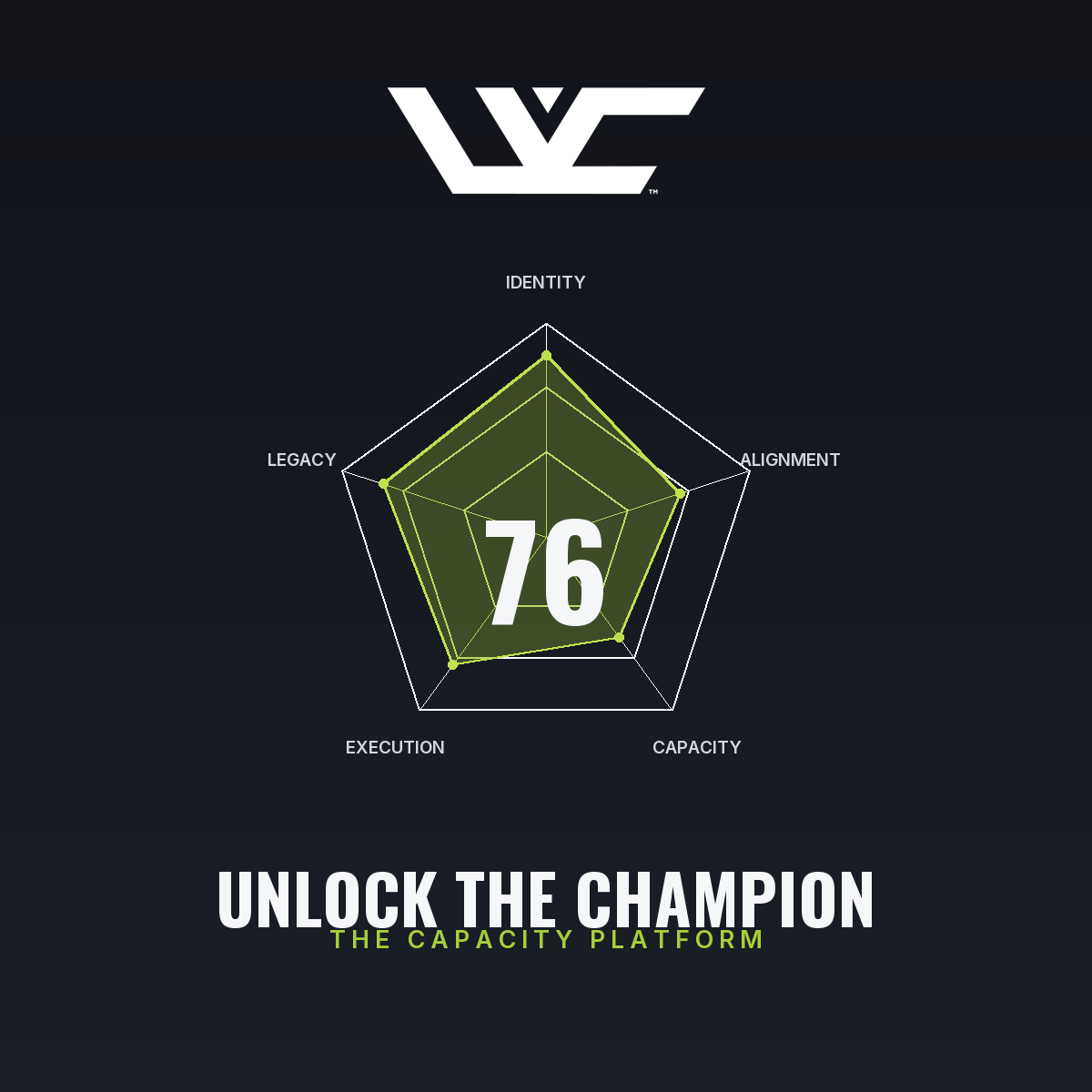
Stats tell you what already happened. Development lives in the five areas underneath the box score — if you know how to see it.
By Freddie Scott II
Founder, Unlock The Champion
The Read — development, made visible across five areas
Measuring athlete development beyond stats means evaluating growth across the internal dimensions that drive performance — identity, alignment, capacity, execution, and legacy — rather than relying solely on box scores, combine numbers, or win-loss records. These internal indicators are not soft observations; they predict whether an athlete will sustain performance, transition effectively, and lead others over time. If your current development model can't surface these dimensions, it isn't measuring development — it's measuring output.
There is probably an athlete in your program right now you are quietly about to lose — the talent is still there, but something underneath has started to slip, and by the time the stat sheet shows it, the conversation you needed to have is already months late. This is about seeing that athlete while you can still reach them.
Why Stats Are a Lagging Indicator of Development
Every athletic department tracks performance data. Points per game. Completion percentage. ERA. These numbers are useful, but they share a critical limitation: they tell you what already happened. By the time a stat line reflects a developmental problem — declining focus, identity fragility, misaligned motivation — the window to intervene has often passed.
Think about the athlete who dominates statistically in their junior season, then goes quiet senior year. Or the prospect who tests elite at the combine but struggles to hold a roster spot for more than two seasons. The stats didn't warn you. The internal dimensions would have.
This is the core argument behind the Made for More Framework, developed by Freddie Scott II — an undrafted athlete who played four NFL seasons, earned his Penn State letter, and built Unlock The Champion to address exactly this gap. It organizes athlete development across five areas — and every one of them can be observed, assessed, and coached before it shows up (or fails to show up) in the stat column.
“
If your current development model can't surface these dimensions, it isn't measuring development — it's measuring output.
The Founder's Desk · Freddie Scott II
The Five Areas That Define Development You Can Actually Measure
1. Identity — Who the Athlete Believes They Are
Identity is the foundation of every decision an athlete makes under pressure. Research on athletic identity — including the foundational work by Brewer et al. (1993) — has long established that over-identification with the athlete role creates fragility: athletes who see themselves only as players struggle to adapt when roles change, injury strikes, or careers end.
What to look for: Can the athlete articulate who they are outside of their position? Do they recover from adversity with perspective, or does a bad game destabilize them for days? Identity strength is observable in how an athlete talks about setbacks, not just how they perform after them.
2. Alignment — Are Their Values, Effort, and Environment Consistent?
An athlete can be physically gifted and deeply misaligned — playing for external validation when their internal driver is purpose, or operating in a culture that rewards individual glory when they're built to lead teams. Misalignment is invisible in stats until it becomes a locker room issue or a transfer portal entry.
What to look for: Is the athlete's daily effort consistent with their stated goals? Do they thrive in this specific culture, or are they visibly out of step with the environment you've built? Alignment assessments go beyond personality tests — they require structured conversation and observation across time.
3. Capacity — What They Can Carry Next
If there is one thing that predicts future performance more reliably than any current stat, it is capacity — the athlete's mental, emotional, and physical bandwidth to handle increasing demand without degrading. It tells you what an athlete can carry next, long before the numbers do.
What to look for: How does the athlete respond when you add responsibility — not just more reps, but more pressure, more leadership expectation, more ambiguity? Do they expand or contract? Capacity isn't ceiling; it's the ability to grow into a higher ceiling under load.
4. Execution — How Consistently Do They Perform the Process?
Execution is the area closest to traditional stats, but it still goes deeper. It isn't just whether the athlete performs — it's whether they perform their process consistently. Do they prepare the same way before a high-stakes game as a mid-week practice? Do they maintain their standards when coaching attention shifts to someone else?
What to look for: Consistency of preparation, coachability under correction, and the ability to self-regulate mid-performance without external cues. An athlete who only executes when watched has a dependency problem that no stat reflects.
5. Legacy — Are They Building Something That Lasts?
Legacy may sound like a post-career concept, but it's a present-tense development indicator. Athletes who think about their impact on teammates, their reputation in the program, and what they're building toward make different decisions on a daily basis. Legacy-orientation correlates with leadership emergence, team cohesion, and long-term career durability.
What to look for: Does the athlete mentor younger teammates voluntarily? Do they talk about the program, the team, and the culture — or only about their own trajectory?
IdentityAlignmentCapacityExecutionLegacy
How to Build a Development Measurement System
You don't need a new software platform to start measuring development beyond stats. You need a structured framework applied consistently. Here is a practical starting point:
Define what each of the 5 areas looks like in your specific sport and program context.
Create observation checkpoints — not just formal evaluations, but structured conversations at key points in the season.
Train your staff to recognize and report on development indicators, not just performance metrics.
Use the data developmentally, not punitively. Athletes become more coachable in these dimensions when the culture makes it safe to be honest about gaps.
Programs that have engaged the Made for More Framework — including at the Division I level, where UTC's work has been recognized by Penn State Athletics — find that these dimensions don't replace performance accountability; they make it more precise.
The dimensions that predict who thrives are the ones most scoreboards ignore.
The Measurement Gap Is a Leadership Gap
If your program can't answer the question "how is this athlete actually developing?" with anything beyond a stat sheet, the gap isn't in your athletes. It's in your measurement system — and it leaves you reacting to problems instead of seeing them coming. Closing that gap gives coaches, Player Engagement Directors, and Athletic Directors a way to see who is thriving and who is quietly slipping while there is still time to act.
The clearest place to start is with your own capacity, right now.Take the free Capacity Read — it takes less than ten minutes and shows you, in plain terms, where you are strong and where you are leaking.
Frequently Asked Questions
Q: What does athlete development beyond stats actually mean?
A: It means measuring the internal dimensions — identity, alignment, capacity, execution, and legacy — that drive long-term performance and career durability. These indicators predict future outcomes rather than simply recording past ones.
Q: Why are stats insufficient for measuring athlete development?
A: Stats are lagging indicators — they reflect what already happened. Internal development dimensions like identity stability and capacity under pressure predict performance before it appears (or disappears) in the numbers.
Q: What is the most important non-statistical indicator of athlete development?
A: Capacity — the athlete's ability to absorb increasing demand without degrading — is widely considered the earliest visible signal of sustainable performance growth. It shows up before the numbers do, predicting how an athlete will respond to elevated pressure, leadership expectation, and career transitions.
Q: How can coaches and athletic directors measure identity development in athletes?
A: By observing how athletes respond to setbacks, how they describe themselves outside of their sport role, and whether a bad performance destabilizes their functioning for an extended period. Over-identification with the athlete role — documented in research by Brewer et al. (1993) — is a measurable risk factor.
Q: What framework do athletic departments use to measure holistic athlete development?
A: The Made for More Framework, developed by Freddie Scott II at Unlock The Champion, organizes holistic athlete development across five areas: Identity, Alignment, Capacity, Execution, and Legacy. It has been applied at the Division I level and recognized by Penn State Athletics.
Q: Where can I start measuring athlete development beyond stats in my program?
A: The free Capacity Read at unlockthechampion.com/app/audit provides an immediate benchmark across the core development areas and is designed for coaches, Athletic Directors, and Player Engagement Directors.
A note from Freddie
“I was an undrafted kid who made it four seasons in the NFL — and I watched teammates with better stats than mine never find themselves once the game ended. The scoreboard never told that story. The five areas would have. I built the Read so you can see your athletes developing before the stat sheet forces the conversation.”
Freddie Scott IIFormer NFL pro · NFL Certified Transition Coach · Founder, Unlock The Champion · Author of Made for More
“
The gap isn't in your athletes. It's in your measurement system.
The Measurement Gap Is a Leadership Gap
Your move
See where your capacity is strongest — and where it's leaking. The free Capacity Read scores you across all five areas in about 10 minutes. No account required. Start with yourself. Then read your program.
Stats tell you what happened; capacity tells you who’s ready. See how our athlete development platform measures the whole person — or bring the message to your program with a team workshop.
The Pride is every coach, athletic director and leader who decided their athletes are bigger than the moment — and worth measuring beyond the box score. If this said something true, pass it on. A coach you know needs it before their next evaluation cycle.